
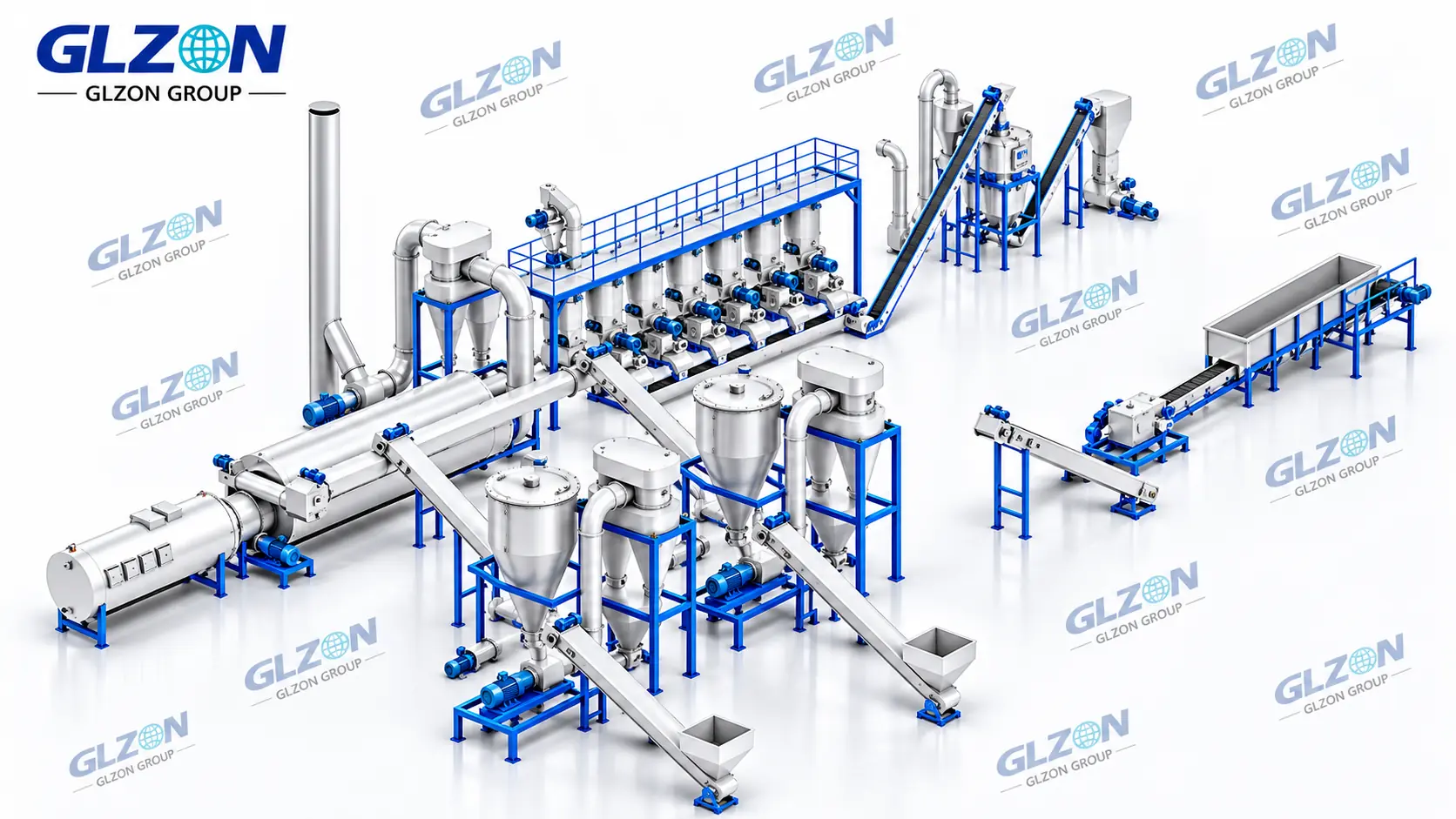
Wood Pellet Production Line: Complete Process, Equipment and Packaging Solutions
A wood pellet production line converts wood residues, sawdust, wood chips and other suitable biomass materials into compact pellets used for heating and industrial energy applications.
Building an efficient pellet plant requires more than a pellet mill. Raw material preparation, moisture control, pellet forming, cooling and packaging must work together to maintain consistent production.
For manufacturers planning a new biomass pellet facility or improving an existing operation, understanding each stage helps with equipment selection, factory layout and production planning.
Shanghai GLZON Equipment Co., Ltd. provides industrial weighing, bagging, conveying and palletizing equipment that can be integrated into the packaging section of wood pellet production lines.
How Does a Wood Pellet Production Line Work?
A typical wood pellet production line processes raw biomass into finished pellets through several stages.
The exact equipment arrangement depends on the raw material, moisture content, required capacity and final pellet specifications.
Typical production workflow:
Raw Material Preparation → Chipping → Crushing → Drying → Pelletizing → Cooling and Screening → Weighing → Bagging → Sealing → Palletizing
When a facility uses prepared sawdust rather than whole logs, some preparation stages may not be necessary.
Main Equipment Used in a Wood Pellet Production Line
1. Raw Material Preparation and Debarking
The first step is preparing suitable biomass for processing.
Common raw materials include:
- Pine and other suitable wood species
- Wood chips and sawdust
- Woodworking residues
- Suitable forestry by-products
- Clean, untreated wood offcuts
When whole logs are used, debarking equipment may remove bark before chipping. Removing excess bark can help control ash content in finished pellets.
Raw material selection also affects drying requirements, pellet quality and production costs.
2. Wood Chipping and Size Reduction
Large pieces of wood must be reduced to a suitable size before further processing.
A wood chipper converts logs and other large materials into smaller chips. The chips then pass through crushing or grinding equipment to produce particles suitable for pellet manufacturing.
Hammer mills are commonly used for finer size reduction.
Particle size should be controlled according to the pellet mill’s requirements. Oversized material can interfere with feeding, while excessive grinding increases energy consumption.
3. Biomass Drying System
Moisture management is an important part of wood pellet production.
Fresh wood may contain too much moisture for efficient pellet forming. A drying system reduces moisture to a level suitable for the selected pellet mill and raw material.
Rotary drum dryers are one option for handling large quantities of wet biomass.
The final moisture target depends on the wood species, processing equipment and product requirements.
An appropriately designed drying system helps maintain stable material feeding and consistent pellet formation.
4. Wood Pellet Mill and Pellet Forming
After preparation and drying, biomass enters the pelletizing stage.
A pellet mill compresses the prepared material through a die to form cylindrical pellets.
Commercial pellet mills are available in different capacities and configurations.
Common pellet diameters include 6 mm and 8 mm, although other sizes may be specified according to the application.
Equipment selection should consider production capacity, die specifications, raw material characteristics, energy consumption and maintenance accessibility.
5. Pellet Cooling and Screening
Wood pellets leave the pellet mill at an elevated temperature.
Before packaging, they must be cooled to a suitable handling and storage temperature.
A pellet cooling system reduces pellet temperature and helps stabilize the finished product.
Screening equipment can then separate loose fines and broken particles from finished pellets.
This process supports consistent packaging and reduces the amount of loose material entering the filling machine.
6. Automatic Wood Pellet Weighing and Bagging
Once pellets have been cooled and screened, they can enter the packaging section.
This is where GLZON wood pellet bagging equipment can be incorporated into the production process.
A typical bagging arrangement may include:
- Finished pellet storage hopper
- Controlled material feeding mechanism
- Electronic weighing system
- Open-mouth bag filling machine
- Bag sewing or heat sealing equipment
- Finished bag conveyor
- Optional checkweighing and palletizing equipment
The weighing controller measures the required quantity of pellets before releasing the material into the bag.
Depending on the machine configuration, operators may place empty bags manually, or automatic bag handling equipment may be used.
GLZON provides pellet bagging solutions for different production requirements.
Explore our Wood Pellet Bagging Machine for more product information.
Wood Pellet Packaging Options for Different Markets
Different customers require different packaging formats.
The appropriate bagging machine depends on how the pellets will be stored, transported and sold.
| Packaging format | Typical application |
|---|---|
| 15 kg bags | Retail fuel packaging |
| 20–25 kg bags | Commercial distribution |
| 50 kg bags | Industrial and wholesale distribution |
| 500–1,000 kg FIBC bags | Bulk industrial supply |
| Bulk handling | Large-volume customers with suitable storage systems |
These are illustrative packaging options. Final bag weights and equipment compatibility should be confirmed for each project.
Semi-Automatic Wood Pellet Bagging Machine
Semi-automatic equipment is suitable for manufacturers that need controlled weighing and filling while retaining operator involvement.
The operator typically positions the empty bag at the filling station. The weighing system measures and dispenses the pellets, and the filled bag moves to the closing section.
This arrangement can be useful when production volumes or investment requirements do not justify complete automation.
Fully Automatic Pellet Packaging Line
For higher production requirements, manufacturers may consider a more automated packaging system.
Depending on the selected configuration, a line may combine automatic bag feeding, weighing, filling, closing, conveying and palletizing.
Integrating these operations can reduce manual bag handling and help maintain continuous production.
Bulk Bag Filling for Wood Pellets
Large-volume customers may prefer FIBC bags rather than individual small bags.
A bulk bag filling system uses a suitable filling station, weighing equipment and bag support arrangement to handle larger packaging weights.
GLZON offers Big Bag Filling Machines for bulk powders, granules and pellets.
Packaging Capacity for a 5–7 Tons/Hour Wood Pellet Plant
Packaging capacity should be evaluated alongside the output of the pellet production equipment.
For example, consider a wood pellet plant producing between 5 and 7 metric tons of finished pellets per hour.
The required theoretical bagging rates would be:
| Bag weight | At 5 tons/hour | At 7 tons/hour |
|---|---|---|
| 20 kg | 250 bags/hour | 350 bags/hour |
| 25 kg | 200 bags/hour | 280 bags/hour |
| 50 kg | 100 bags/hour | 140 bags/hour |
Automatic Palletizing for Wood Pellet Bags
After weighing and closing, finished pellet bags must be prepared for storage or shipment.
Manual palletizing can require considerable labor, particularly in higher-capacity plants.
An automatic palletizing system transfers filled bags onto pallets according to a selected stacking arrangement.
A typical downstream system may include:
- Filled bag conveyor
- Bag positioning equipment
- Robotic palletizer
- Pallet handling equipment
- Optional stretch wrapping system
The appropriate palletizer depends on bag dimensions, weight, packaging material, required throughput and pallet configuration.
GLZON provides Robotic Palletizing Solutions for industrial packaging applications.
What to Consider Before Buying Wood Pellet Packaging Equipment
Choosing the correct packaging equipment helps avoid bottlenecks after pellet production.
Before requesting a quotation, manufacturers should confirm the following requirements.
Pellet Characteristics
Provide the pellet diameter, approximate bulk density, moisture content and expected amount of fines.
These characteristics influence feeding performance, hopper design and weighing behavior.
Target Packaging Weight
Confirm whether the production line will use 15 kg, 20 kg, 25 kg, 50 kg or bulk bags.
Different bag formats may require different filling and closing arrangements.
Required Production Speed
The packaging system must match the output of the upstream pellet manufacturing equipment.
For example, a line producing 6 tons per hour would require a theoretical capacity of 240 bags per hour when filling 25 kg bags.
Practical operating margins should also be considered.
Bag Material and Closing Method
Packaging material affects the choice of closing equipment.
Woven and paper bags may use sewing systems, while suitable plastic and laminated bags may use heat sealing.
The correct method depends on the bag construction and storage requirements.
Factory Layout and Utilities
Available floor space, machine height, conveyor direction, electrical supply and compressed air should be reviewed before selecting equipment.
The location of the pellet storage hopper and finished product handling area should also be considered.
Dust Management and Maintenance
Wood pellet handling can generate fines and dust.
Suitable dust collection, housekeeping, equipment access and relevant combustible-dust safety measures should be incorporated into the plant design.
GLZON Wood Pellet Bagging and Packaging Solutions
Shanghai GLZON Equipment Co., Ltd. specializes in industrial filling, weighing, bagging and palletizing equipment.
For wood pellet manufacturers, GLZON can review packaging requirements and recommend suitable equipment configurations for finished pellet handling.
Available equipment categories include:
- Automatic and semi-automatic bagging machines
- Electronic weighing and filling systems
- Bulk bag filling equipment
- Bag sewing and sealing equipment
- Product conveyors
- Robotic palletizing systems
A packaging system may be supplied as individual equipment or configured for integration with an existing production line, subject to technical review.
For factories that already have pellet mills, dryers and cooling systems, upgrading the packaging section may be a practical way to address downstream handling limitations.
Frequently Asked Questions
What equipment is needed for a wood pellet production line?
A typical line includes raw material preparation equipment, a chipper, crusher, dryer, pellet mill, cooler, screening equipment and a suitable packaging system. The exact configuration depends on the raw material and production requirements.
Can wood pellets be packed into 25 kg or 50 kg bags?
Yes. Wood pellets can be packaged in 25 kg, 50 kg and other bag sizes using appropriately configured weighing and filling machines.
What is the difference between semi-automatic and fully automatic pellet bagging?
Semi-automatic systems generally require operators to position empty bags, while fully automatic configurations can automate additional bag handling, filling, closing and conveying operations.
Can a wood pellet packaging machine connect to an existing production line?
Yes, provided the equipment is technically compatible. Hopper connections, production speed, available space and control interfaces should be reviewed before integration.
How do I choose the correct pellet bagging machine capacity?
Start with the finished pellet output in tons per hour and the target weight per bag. Calculate the required bags per hour, then check whether the selected system can maintain that rate under actual operating conditions.
Does GLZON provide customized pellet packaging solutions?
GLZON offers project-based industrial packaging equipment configurations. Customers can submit their pellet specifications, bag requirements, production targets and factory layout for technical review.
Request a Wood Pellet Bagging Machine Quotation from GLZON
Are you planning a new wood pellet production facility or looking to upgrade your existing pellet packaging section?
Shanghai GLZON Equipment Co., Ltd. can help you evaluate suitable weighing, filling, conveying and palletizing equipment for your application.
To receive a quotation, please share your product specifications, required bag weight, production capacity, automation preference and destination country.
Contact GLZON
Website: www.bagging-machine.com
Factory: No. 409, Xintuo Road, Songjiang District, Shanghai, China
Contact our team to discuss your wood pellet packaging project.